



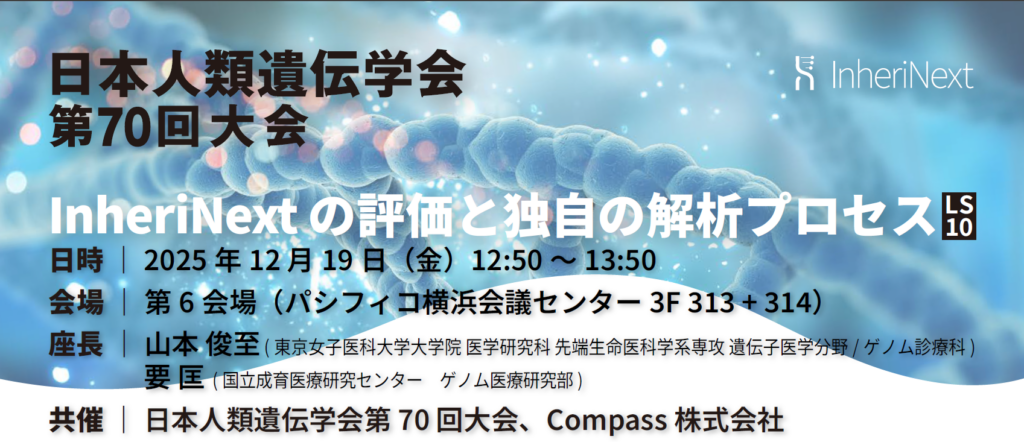
Compass Bioinformatics, a subsidiary of BRIM Biotech Inc., proudly announced that its AI-driven rare disease genetic diagnostic platform, InheriNext, was featured at the 70th Annual Meeting of the Japanese Society of Human Genetics (JSHG) on December 19, 2025. At this prestigious national event, leading Japanese experts presented real-world clinical cases demonstrating InheriNext’s efficiency and accuracy in rare disease diagnostics—making Compass one of the few innovative startups invited to present at such a high-level national medical conference.
The JSHG Annual Meeting is Japan’s most representative event in genetic medicine and is widely recognized as one of the largest and most influential genetics conferences in the Eastern Hemisphere. Held in Yokohama, the conference brought together over a thousand clinicians and researchers from Japan and abroad. Compass’s inclusion in the official scientific program underscored that its technology had reached a level of validation within Japan’s healthcare system and was progressing toward integration into real-world clinical workflows.
InheriNext: AI Accelerating Rare Disease Diagnosis
InheriNext is an AI-powered platform capable of automatically analyzing whole-genome data and prioritizing candidate variants within minutes. By highlighting clinically relevant genetic changes, the platform helps physicians focus on the most critical variants hidden within massive sequencing datasets—significantly shortening the time required for rare disease diagnosis.
Beyond speed, InheriNext continues to evolve through the accumulation of clinical cases and expert feedback. This iterative refinement has strengthened its reanalysis capabilities, positioning the platform as a core tool for improving both efficiency and consistency in rare disease diagnostic workflows.
From Manual Burden to AI-Assisted Precision: Cardiomyopathy in Clinical Practice
One of the featured sessions, “Approach to Improve Accuracy and Efficiency in Variant Pathogenicity Evaluation: InheriNext Experience in Cardiomyopathy,” was presented by Dr. Yohei Miyashita of the National Cerebral and Cardiovascular Center (NCVC).
Cardiomyopathy is a representative cardiovascular disease with a strong genetic basis, involving numerous known and yet-to-be-clarified genes. At NCVC, clinical genetic testing for hypertrophic cardiomyopathy is already established alongside Grand-Star Next, a nationwide genome consortium study for cardiomyopathies. However, large-scale genomic sequencing inevitably generates an overwhelming number of variants, placing an immense burden on expert curators responsible for manual interpretation.
Dr. Miyashita described how clinical practice demands not only accuracy but also timely reporting—making it increasingly difficult to rely solely on manual curation. To address this challenge, the NCVC team evaluated InheriNext as a primary screening tool for cardiomyopathy cases, directly comparing its performance with expert-led manual workflows.
The results presented at JSHG demonstrated that InheriNext could effectively balance efficiency and accuracy, substantially reducing the workload associated with variant screening while maintaining clinically reliable evaluations. The session further explored how automated systems and human expertise can be clearly delineated into complementary roles, paving the way for standardized workflows that ensure both speed and trustworthiness in variant interpretation and reporting.
Streamlining Neuromuscular Disease Diagnosis Under Resource Constraints
Another key presentation, “Streamlining Genetic Diagnosis of Neuromuscular Diseases: Efficient Variant Annotation via Lab-Industry Collaboration,” was delivered by Dr. Wakako Yoshioka from the National Center of Neurology and Psychiatry (NCNP).
Neuromuscular diseases are often rare and highly specialized, yet diagnostic resources remain limited. NCNP serves as a national hub, providing central pathological evaluation for over 70% of muscle biopsies performed in Japan and leading genetic diagnosis efforts for hereditary myopathies—including many conditions not yet covered by national insurance reimbursement.
Dr. Yoshioka outlined how her team has developed a custom sequencing panel covering 115 disease-associated genes, while also applying whole-genome sequencing to uncover novel disease genes in unresolved cases. The most significant bottleneck, however, lies in variant interpretation, which requires continuous integration of population data, computational predictions, and disease databases.
Without dedicated bioinformaticians, maintaining up-to-date and well-structured annotation files poses a significant operational burden. Through collaboration with Compass, the team worked to optimize annotation file generation and validated the InheriNext scoring system in real-world neuromuscular disease cases. The results showed meaningful improvements in workflow efficiency, consistency, and scalability—demonstrating how AI tools can directly support highly specialized research environments operating under constrained human resources.
High-Level Collaboration with National Medical Centers
The presentation lineup at JSHG included experts from three of Japan’s five major national medical research centers:
-
- NCVC (National Cerebral and Cardiovascular Center) for cardiovascular disease
-
- NCNP (National Center of Neurology and Psychiatry) for neuromuscular disease
-
- NCCHD (National Center for Child Health and Development), which served as session chair
Across sessions, speakers shared validation results of InheriNext’s scoring system using real clinical cases, comparing AI-assisted analysis with expert manual interpretation in terms of speed, accuracy, and reproducibility. These discussions directly addressed a central clinical challenge in modern genomics: how to scale diagnostic capacity as next-generation sequencing becomes routine, without sacrificing quality or clinical confidence.
Expanding Impact in Japan and Beyond
Compass has actively expanded its presence in Japan, collaborating with over 40 university hospitals nationwide. By working closely with national medical research centers and validating InheriNext against existing clinical workflows, Compass demonstrated how AI-based systems can be realistically integrated into Japan’s healthcare infrastructure.